

Greatest Roamers of All Time (G.R.O.A.T) Part Two
Meet The Roaming Eight
In July, our first G.R.O.A.T series revealed the extraordinary movements of elephants – from Morgan’s bold trek into Somalia to Monsoon’s mountain ascent. In part two of the series, we follow the adventures of eight elephants whose remarkable journeys have deepened our understanding of how these giants navigate Kenya’s changing landscapes.
Decades of tracking data has revealed their paths in extraordinary detail, each movement helping shape the bigger picture of elephant conservation.
Meet the latest GROATs:
Frank – The Elusive Explorer

Frank, a 45-year-old bull © Saba Douglas-Hamilton/Save the Elephants
Named after our CEO, Frank Pope, this impressively large bull has a taste for adventure. The elephant is known for his love of high ground, often venturing up the rugged Matthews Range, in northern Kenya, for months at a time. In April and May, during musth, he makes seasonal visits to Samburu National Reserve in search of females, then returns to his mountainous hideaway.
When Frank’s collar stopped transmitting in 2015, at the height of the second ivory poaching crisis, we feared he had been lost forever. Then, in a remarkable twist, Frank was spotted in May this year, alive and seemingly in excellent health in the heart of Samburu National Reserve. Having dropped his collar, his whereabouts for the past 10 years remains a mystery, making this long-tusked mountaineer a symbol of resilience.
Nyiro – The Master of Miles

Nyiro in Namunyak Wildlife Conservancy © Angus Carey-Douglas/Save the Elephants
In 2019, after decades of absence due to poaching, elephants returned to the lands east of Lake Turkana, between Mt. Kulal and Mt. Nyiro. Our team found a group of about 10 bulls and fitted one with a GPS collar, naming him Nyiro after the nearby mountain.
From his starting point on the lake’s shores, Nyiro traveled to South Horr valley and, once in musth, embarked on an epic journey southeast to Merti and then Kom in Samburu, covering over 300 miles in six months. After musth, he returned home at a gentler pace.
Though Nyiro dropped his collar soon after, he was spotted again in 2021 and a new collar was deployed. He repeated the same long-distance journey the following year, traversing rocky valleys, community lands, and protected areas, no doubt in search of females. Nyiro’s travels reveal the importance of space, connectivity, and migratory routes for bulls and for maintaining Kenya’s elephant genetic diversity.
Magado – The Pathfinder

Magado and her herd © David Daballen/Save the Elephants
Magado’s story begins in Shaba National Reserve, located to the east of Samburu, where she was born into the Conservation Ladies family. Orphaned young after ivory poaching claimed all of the older females in her herd, she joined a group of other young females believed to be orphans.
In May 2016, Save the Elephants deployed a satellite tracking collar on Magado. For the first two years, she and her family would leave Shaba to travel 71 miles to Meru National Park. Each time they neared the park, they came up against a fence, unable to get past it due to the lack of older females to guide them to the opening. Other herds with experienced matriarchs seemed to find their way around the fence, but Magado’s family would search for days before returning to Shaba, defeated. Eventually, Magado and her herd found their way into the park.
But Magado didn’t stop there. She went on to travel far beyond the usual route of our tracked elephants, journeying over 100 miles south east to Tana River and Garissa, reaching Kora National Park, a risky, more arid landscape, dominated by open scrubland with pockets of greenery along riverbanks. Interestingly, Magado has not left this area since her last trip there in April 2020.
Magado’s movements reveal an extraordinary instinct to explore, even when robbed of the experience of older matriarchs.
Luna and Orchid – The Traveling Band of Orphans
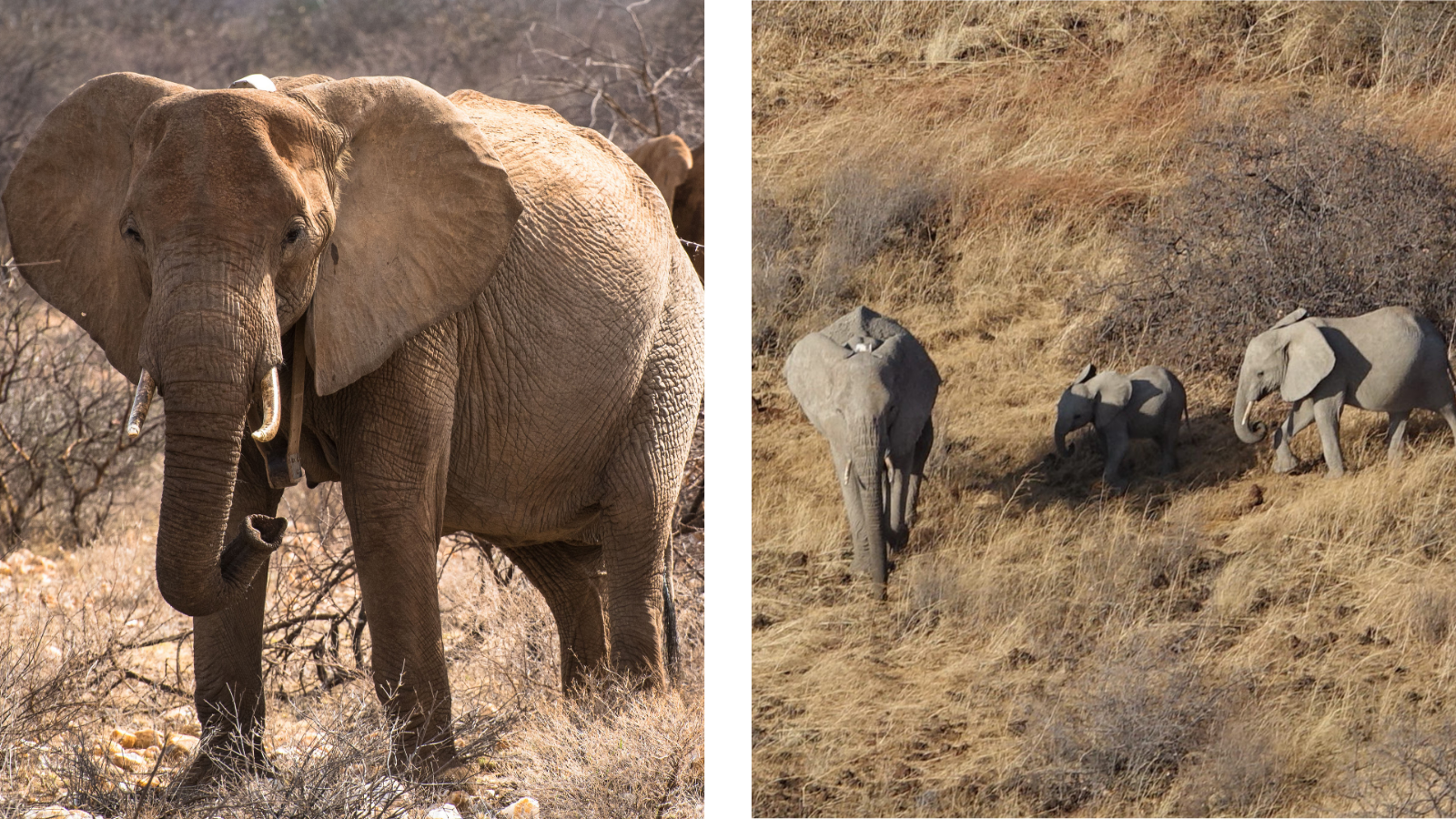
Left: Luna and her calf © Jane Wynyard/Save the Elephants | Right: Orchid with her herd in Nakuprat Gotu © Angus Carey-Douglas/Save the Elephants
Luna, from the once dominant Planets family, and Orchid, born into the Flowers family of Samburu, have both weathered the toughest of times. They are living testaments to endurance and survival. As calves, they survived the devastating ivory poaching wave that wiped out most of their family members, including their mothers, Neptune and Maua.
Left without elders to guide them, Luna and Orchid did what elephants do best: they adapted. Joining forces, the two banded together, joined by another orphan named Shafaa. Together, the trio started travelling beyond their home range, even surprising our researchers by walking 70 miles from Samburu to Meru National Park. Here they hit the same fence that Magado had, facing the same challenge of not having mature and experienced females to guide them. Our tracking data shows Orchid racing up and down the barrier, desperate to find an opening. Eventually, she broke through and made it to the river inside the park.
With time, this alliance broke apart, Shafaa sadly died, and Luna re-joined with the remaining members of the Planets herd. Today, Luna regularly moves between Samburu National Reserve and Meru National Park, tracing the same route she had walked with her small band of orphans. Orchid, on the other hand, chose the solitary life, roaming independently with her calves, yet also periodically revisiting the old routes of her youth.
Maungu – The Adapter
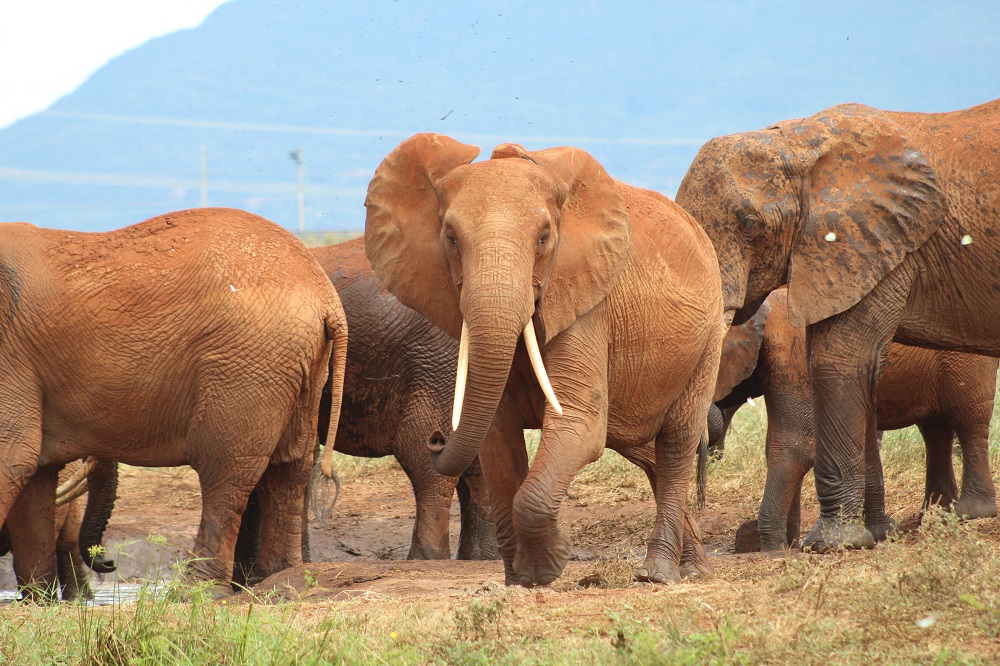
Maungu (center) at a watering hole in Tsavo © Courtesy of Save the Elephants
Maungu, a hardy female estimated to be 30 years, was collared in 2016 to help researchers monitor the impacts of the Standard Gauge Railway (SGR) on elephant movement in the Tsavo ecosystem.
For years, she spent her time around the Ndara plains in Tsavo East National Park, avoiding the SGR and major nearby highway. Her family was often tracked pacing along the fenceline, not making use of the underpasses built to reconnect their range. Then last year, she decided to cross over into the Taita Ranches, beginning a regular journey that continues today. She now moves back and forth with relative ease, sometimes going as far as the Southern Taita ranches, roughly 50 miles away. It may not be a very long journey, but it is a great case study of how elephants gradually adapt to major landscape changes.
Jenga – The Great Data Collector
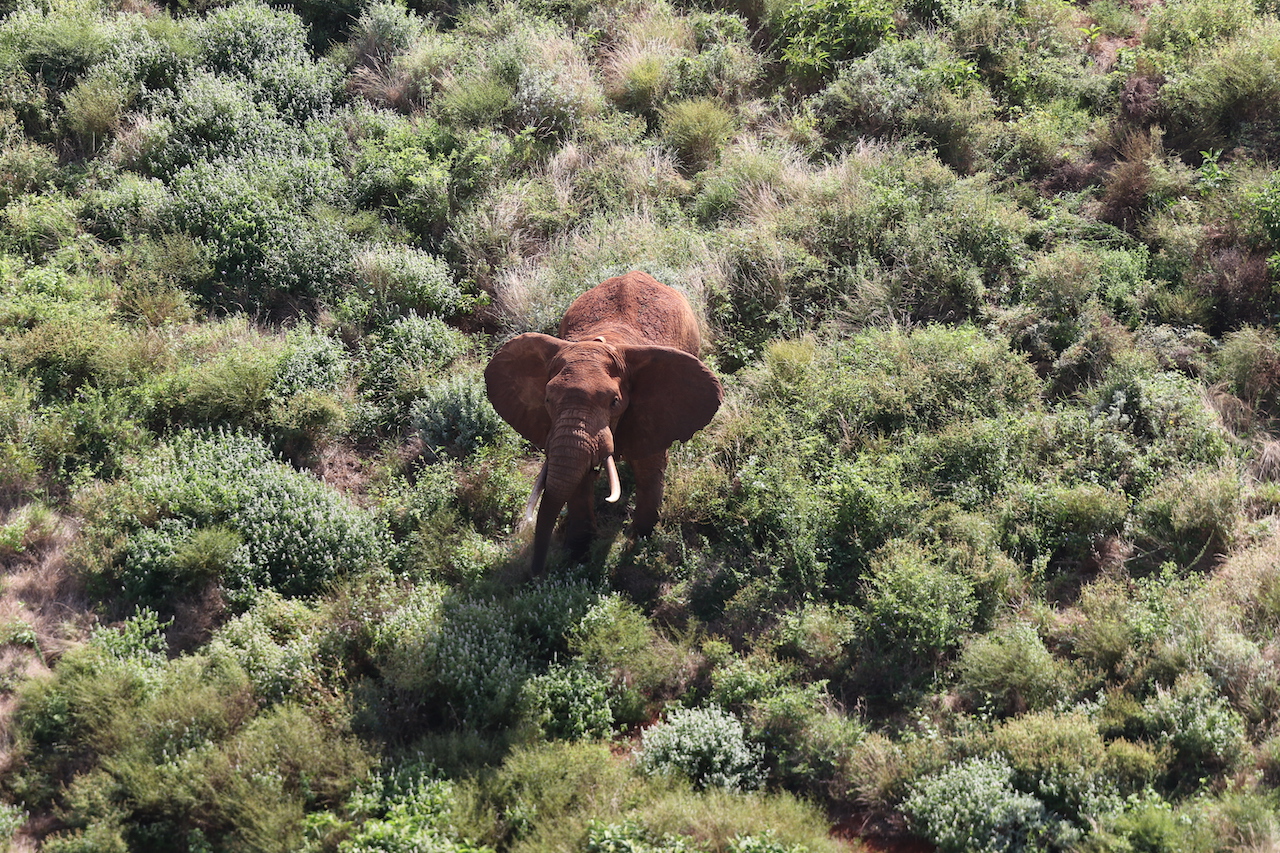
Jenga in the Tsavo Conservation Area © Tsavo Trust
Jenga, a magnificent bull now in his early forties, has produced one of the most valuable datasets of our tracked elephants in Kenya’s Tsavo ecosystem. This red giant was collared in 2018 as part of a large-scale operation to understand elephant movement in Tsavo. During the collaring, he was found with a spear wound on his face, a harsh reality of the increasing challenge of human-elephant conflict in the country. The wound was treated during the operation, and from that moment, Jenga’s journey became one to watch.
He travelled from central Tsavo West National Park through Chyulu, Kuku, and Mbirikani ranches, through the Kimana corridor and into Amboseli National Park, a journey of over 125 miles. He became one of the first tracked elephants recorded using the newly constructed Kimana wildlife crossing, showing how connectivity between protected areas supports the movement of migratory species.
Jenga’s movements are no longer tracked via GPS collar, but his data continues to shape wildlife corridor protection efforts across southern Kenya, helping maintain the connection between these wild spaces and elephant populations.
Goshi – The Rogue Wanderer

Goshi in Tsavo © Meha Kumar/Save the Elephants
Goshi, an emerging tusker on course to reach super tusker status, is as notorious as he is recognisable. He is a hefty bull with long, straight tusks, and a reputation for crop raiding within the Sagalla community in southern Kenya. His fondness for crops and frequent farm visits prompted us to fit him with a GPS tracking collar last year, enabling rapid response teams to act before major damage occurs.
Despite his notoriety and love of Sagalla, Goshi has proven to be an intelligent and adaptable traveller, contributing to our insights on elephant use of the SGR underpasses. He is a frequent user of the underpasses, especially the Ndara corridor underpass, confidently using it to move between Tsavo East National Park and the Taita ranches.
Why Their Journeys Matter
From mountain peaks to low river valleys and dryland plains, these elephants are expanding our knowledge of their movements. Every journey and data point helps us understand how they adapt to change, and why protecting wildlife corridors is vital for their survival.
Keep Elephants Roaming – Support Their Journey Today
Celebrate the GROATs (Greatest Roamers of All Time) by shopping the Elephant Migration Collection – a tribute to elephants and their epic journeys.